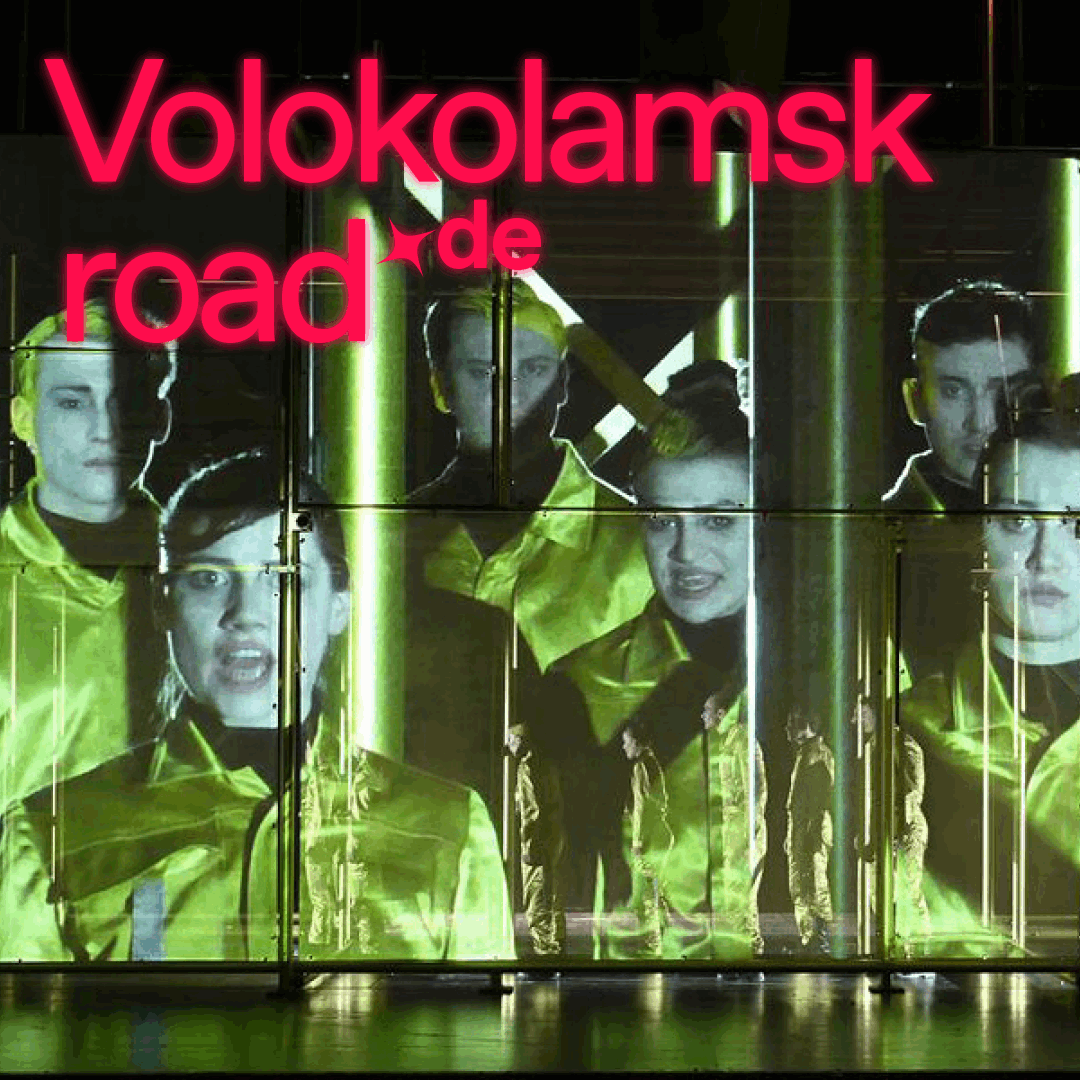
Volokolamsk Road (DE)
University of Music and Theatre Felix Mendelssohn Bartholdy (Leipzig, Germany)
"I had a dream. It was a nightmare
I woke up and everything was fine."
Wolokolamsker Chaussee is one of the major arterial roads from Moscow to the west. There, two thousand kilometres from Berlin and one hundred and twenty kilometres from Moscow, the advance of the German Wehrmacht was halted in the winter of 1941. For Heiner Müller, the desperate battles along the Chaussee mark historical-political turning points in the rest of German history. As in other works before, he examines whether what has been associated with humanity in the centuries since the Renaissance and the Enlightenment necessarily falls by the wayside when it comes to survival. For the three other parts he draws on motifs from works by Anna Seghers, Franz Kafka and Heinrich von Kleist to examine themes that have once again become pivotal points in the history of 'real existing socialism' since the end of the war. The arc of memory ranges from the repressed trauma of the workers' uprising in 1953 shortly after Stalin's death, with its political and international consequences, to the transformation of the development of socialism into a bureaucratically encrusted state apparatus, to the suppression of the Prague Spring in August 1968.
Author: Heiner Müller
Directing: Josua Rösing
Set and Costume design: Ariella Karatolou
Dramaturgy: Kerstin Behrens
Musik: Thies Mynther
Video: Jens Bluhm
Light design: Rolf Pazek
Cast: Felix Bronkalla, Jakob Fließ, Leonie Hämer, Kaya Loewe, Mina Pecik, Jannis Roth, Rieke Seja, Willi Sellmann
Tags
Vstupenky na Volokolamsk Road (DE).
University of Music and Theatre Felix Mendelssohn Bartholdy (Leipzig, Germany)
"I had a dream. It was a nightmare
I woke up and everything was fine."
Wolokolamsker Chaussee is one of the major arterial roads from Moscow to the west. There, two thousand kilometres from Berlin and one hundred and twenty kilometres from Moscow, the advance of the German Wehrmacht was halted in the winter of 1941. For Heiner Müller, the desperate battles along the Chaussee mark historical-political turning points in the rest of German history. As in other works before, he examines whether what has been associated with humanity in the centuries since the Renaissance and the Enlightenment necessarily falls by the wayside when it comes to survival. For the three other parts he draws on motifs from works by Anna Seghers, Franz Kafka and Heinrich von Kleist to examine themes that have once again become pivotal points in the history of 'real existing socialism' since the end of the war. The arc of memory ranges from the repressed trauma of the workers' uprising in 1953 shortly after Stalin's death, with its political and international consequences, to the transformation of the development of socialism into a bureaucratically encrusted state apparatus, to the suppression of the Prague Spring in August 1968.
Author: Heiner Müller
Directing: Josua Rösing
Set and Costume design: Ariella Karatolou
Dramaturgy: Kerstin Behrens
Musik: Thies Mynther
Video: Jens Bluhm
Light design: Rolf Pazek
Cast: Felix Bronkalla, Jakob Fließ, Leonie Hämer, Kaya Loewe, Mina Pecik, Jannis Roth, Rieke Seja, Willi Sellmann
Registrácia
Organizátor podujatia
V prípade akýchkoľvek otázok ohľadom podujatia - vstupeniek, organizácie, lokality, prosíme kontaktujte organizátora podujatia.
Partneri
Za pomoc s akciou ďakujeme naším partnerom, ktorými sú